Protein aggregation and amyloid fibril formation remain major challenges in biomedicine, particularly in understanding disease pathology and developing therapeutic formulations. A research team led by Professor Ling-Hsien Tu from the Department of Chemistry at National Taiwan Normal University successfully demonstrated that iron–chlorophyllin nanoparticles can stabilize human calcitonin (hCT), thereby improving the stability and bioactivity of hCT and providing a potential new strategy for hCT drug formulation.
Calcitonin is an important peptide hormone involved in regulating blood calcium levels, and is widely used in the treatment of osteoporosis and hypercalcemia. However, hCT readily undergoes self-aggregation in aqueous solutions, leading to amyloid formation that compromises its bioactivity and therapeutic efficacy. Owing to this high aggregation propensity, salmon calcitonin (sCT) is currently used in most commercial formulations as a substitute for hCT.
Although several hCT variants with high sequence homology have been designed to address protein aggregation, undesirable immune responses remain unavoidable. Patients may experience adverse effects such as nausea and gastrointestinal discomfort. As a result, if hCT is to be developed as an active pharmaceutical ingredient, there is an urgent need for effective inhibitors capable of stabilizing hCT and preventing amyloid fibril formation.
Professor Tu’s research focuses on the mechanisms underlying amyloid fibrillation and on the use of natural small molecules or novel materials to interfere with protein aggregation in order to better understand the relationship between protein aggregation and disease. In search of materials capable of stabilizing proteins, the team investigated iron–chlorophyllin synthesized by the group of Professor Mei-Yi Liao from the Department of Applied Chemistry at National Pingtung University.
Iron–chlorophyllin has previously been identified as a promising candidate for bladder cancer therapy. Its nanoparticle formulations exhibit excellent stability and synthetic accessibility, making them attractive materials for biomedical applications. The study, which took approximately two years to complete, involved the synthesis of two porphyrin derivative-coated nanoparticles, Fe₃O₄@Chl/Fe and Fe₃O₄@Chl/Cu. A series of biophysical techniques, including transmission electron microscopy (TEM), dynamic light scattering (DLS), and isothermal titration calorimetry (ITC), were implemented in the analysis.
The results demonstrated that Fe₃O₄@Chl/Fe exhibited superior inhibitory activity toward hCT aggregation compared with Fe₃O₄@Chl/Cu. The team further employed a benzothiazole-based fluorescent probe to monitor hCT amyloid formation, confirming that Fe₃O₄@Chl/Fe effectively reduced amyloid fibril formation. In addition, Bis-ANS and Nile red assays further demonstrated that the nanoparticles significantly suppressed hCT fibrillation.
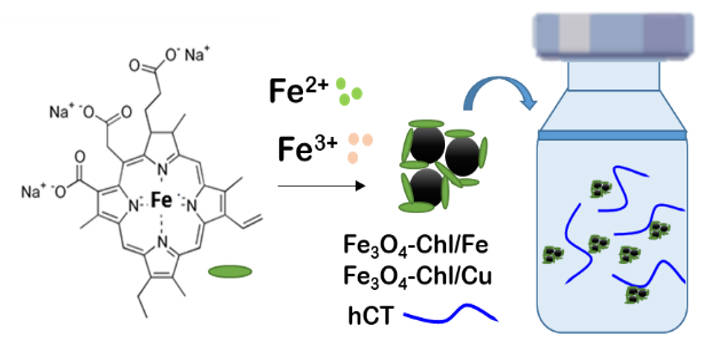
Figure caption: Newly identified function of iron–chlorophyllin nanoparticles: stabilizing calcitonin and inhibiting calcitonin amyloid fibril formation.
Professor Tu noted that the findings further highlight two critical factors governing nanoparticle–protein interactions: nanoparticle stability and appropriate surface modification. By utilizing an easily synthesized nanomaterial, the research team successfully prevented hCT amyloid formation. The study not only revealed a new function of iron–chlorophyllin nanoparticles, but also provided a promising strategy for stabilizing hCT and supporting future pharmaceutical development.
The researchers further suggested that improving the stability and ease of storage of calcitonin could facilitate the development of more convenient dosage forms, such as nasal sprays, potentially improving patient accessibility and compliance. However, Professor Tu emphasized that the current work remains at the basic research stage, and that future formulation development may become an important direction for biotechnology companies.
Iron–chlorophyllin nanoparticles have previously been explored for bladder cancer therapy because light irradiation induces heat generation and reactive oxygen species production, enabling effective killing of bladder cancer cells. Although this photoreactive property was not utilized in the present study, Professor Tu revealed that follow-up investigations are currently underway. Preliminary findings suggest considerable potential: under light irradiation, large protein fibrillar structures may be fragmented into smaller species, potentially facilitating metabolic clearance of aggregated proteins and opening the door to additional biomedical applications.
(This article was provided by The Center of Public Affairs.)
Source:
Wu, Y. H., Chang, Y. P., Hsu, C. C., Chen, Y. L., Lin, P. H., Hsu, T. W., Liu, W. M., Lai, Y. J., Liao, M. Y., & Tu, L. H. (2023). Synthesis of Fe3O4-Chlorophyllin Nanoparticles for Preventing Amyloid Formation by Human Calcitonin. ACS Applied Nano Materials, 6(13), 12598-12608. https://doi.org/10.1021/acsanm.3c02664